
28. A new year!

I’m finally pretty much caught up with the blog posts, and I’m going to try to keep it that way. Now that I’m writing more about the present again, I can discuss everything in a bit more detail, and I won’t always write on a monthly basis anymore—sometimes I’ll focus more on specific topics. As I write this, we’re just past the halfway point of 2026, and I’ve already experienced and gone through plenty, so I have plenty to write about. So let’s start at the beginning—January 2026—and see where this blog takes us.

Faecal worm egg count.
The year started with a nice bit of snow, cold weather, and yet still beautiful conditions. The horses all look great and have a nice, fluffy coat. At the end of the day, after I’ve brought the horses inside, I refill the hay racks for the next day and remove as much manure as possible from the stall and paddock. With an emphasis on AS MUCH AS POSSIBLE. This is often truly impossible in the winter! If anyone has any tips, I’d love to hear them. When it’s this cold, the manure from the morning is often already frozen and/or covered in snow again by the end of the day, and I can’t get it cleaned up—which then creates a lot of work in the spring...
Something many other horse owners might recognize is that you automatically check the horses’ manure while mucking out—after all, it tells you a lot about your horse’s condition. So, in mid-January, I found a pile of manure with a worm in it. I hadn’t dewormed him, so I hadn’t expected to find any worms. The pile of manure turned out to be from Wylano, my yearling stallion. It was a small, thin, white worm; I couldn’t immediately identify what kind of worm it was—it wasn’t a roundworm or a bloodworm; it looked most like a pinworm. So I decided to keep an eye on it. A few days later, I found several piles of manure, this time with as many as 10–15, maybe even 20 worms per pile. NOT GOOD! I sent the photos to my vet—help, what should I do now!
Of course, she asked when he had last been dewormed; that was in November 2025, when no worms were found. She also wanted to know what he looked like and what his condition was. As you can see in the photo, he looked good. For a yearling, he had a nice, shiny winter coat, was well-fed, and generally made a very fit impression. That didn’t add up with the number of worms I found—you’d expect a horse that was critically ill.
After discussing the deworming treatments I’d already administered, we decided to deworm him again with a different treatment, see if anything else comes out, wait two weeks, and then possibly do a manure test.
Just as I said, I did it. I dewormed him again, and I gave Star a treatment right away too, since they’re out in the pasture together anyway. Of course, after the deworming treatment, I didn’t find any more worms.... It remained a bit of a mystery. A good month later, I suddenly found worms again, so I immediately collected some manure and sent the worm along for the manure analysis.

The results of the test can be seen in the photo here. Here’s a quick explanation in simple terms:
Oxyuris Equi = Pinworm
Parascaris Equorum = Roundworm
Fasciola hepatica = Liver fluke
Low levels of these three species were detected. The worms I had seen were definitely not roundworms, as those are much larger and thicker, and the liver fluke isn’t visible in the manure.
In the end, my suspicion that it was Pinworm remained. With Pinworm, it’s important to keep the area around the anus clean, as this is where these worms lay their eggs. After the fecal exam, I didn’t find any more worms, and I didn’t deworm him again until the next scheduled deworming for all the horses. The veterinarian also thought this was best, since Wylano didn’t seem sick in any other way.
Troublemaker.
With Credi, it’s never boring—there’s always something going on. If she isn’t destroying herself, she’s destroying something around her. This time, it was her winter blanket’s turn. When I got to the stable that afternoon, she had completely torn her blanket open from front to back. Good thing I always have a spare blanket on hand. This one was definitely ready for the trash!
Spring.
Spring was slowly arriving, the temperature was rising a bit, and the horses’ training sessions could start up again. The foaling and breeding seasons were also approaching once more.
Credi had to work toward her studbook registration in April; I wanted to ride Infinity and Sensation in the course I’d signed up for in May; and Issy also had to get back to work now that she wouldn’t be having a foal this year. That last part turned out to be a bigger challenge than expected. For the first time in 10 years, Issy didn’t have a foal at her side—and so she had energy to spare. I wasn’t entirely prepared for this, and she certainly kept me on my toes the first few times. Whereas I could normally just hop on and ride off, things were a bit more nerve-wracking now. To get to the arena, we always had to ride a stretch across the campground or along the dog trail. Everything seemed scary to her, and she would regularly rear up on her hind legs, only to try to bolt. Not something I was used to seeing from her! It really took a lot of effort to get her under control again; people who saw me riding would ask if she was still a young horse. But no, this mare is already 14—but that doesn’t bother her at all! Luckily, she’s as steady as a rock, and I can always laugh it off.

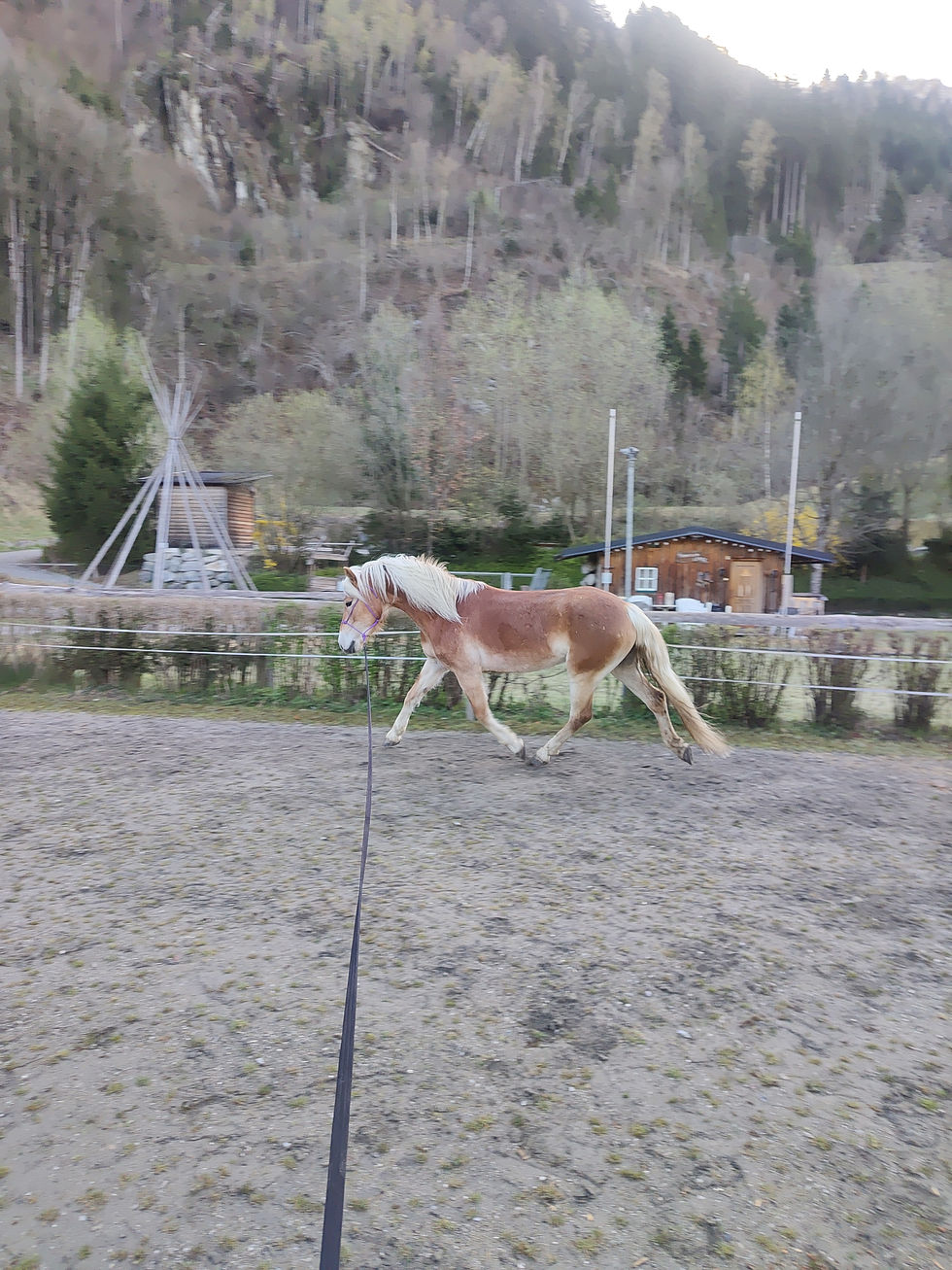
Infinity and Sensation had also found their speed, so I decided to start their training off gently with some lunging. I was able to ride Infinity comfortably right away—she’s always quick but also always well-behaved. Sensation has always been well-behaved too, and even now, after a few weeks of lunging, I was able to ride him comfortably again. Or so I thought. Fast forward to late April, by which time I’d already been riding him more often. So now, too, I wanted to go for a ride. It was a bit windy and he seemed a little frisky, so I decided to lunge him briefly before mounting. While lunging, he seemed very relaxed, so I mounted. As always, right at the entrance to the arena, my saddle shifted slightly, and I shifted my weight a bit to the right to adjust it. This wasn’t unusual either; since he doesn’t have a withers, this happens quite often. I was about to walk away with the reins held at half-length when, after two steps, he decided to completely lose it! All four feet off the ground, and this guy thought for a moment he was a seasoned rodeo horse. I couldn’t stay on and flew off with quite a bit of force, landing on my tailbone. Out of reflex, I didn’t let go, and the reins were yanked through my fingers, burning them in the process. Adrenaline really kicks in at a moment like that, and I got right back up—and was actually pretty angry, because what kind of reaction was that from him! I lunged him for a while longer, until someone came to help me get back on. After that, he let me ride him obediently, as if nothing had ever happened. This story had a little twist at the end, but more on that another time!
In the next blog post, we’ll take a step back to March, when the foaling season began. And unfortunately, that’s when I was forced to face reality. Life isn’t always sunshine and roses; sometimes it comes with a lot of bad luck, and nature also reminds us that it’s not all that easy.
Love, Fabiënne
Comments